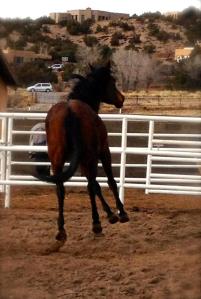
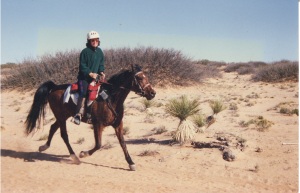
Training is something not just for horse trainers to do, but for horse owners too.
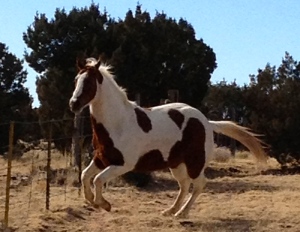
Continue reading Practical application of liberty horse training

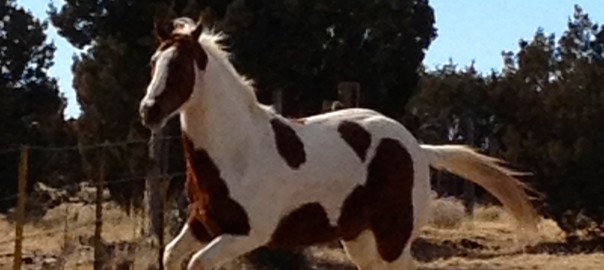
Training is something not just for horse trainers to do, but for horse owners too.
Continue reading Practical application of liberty horse training
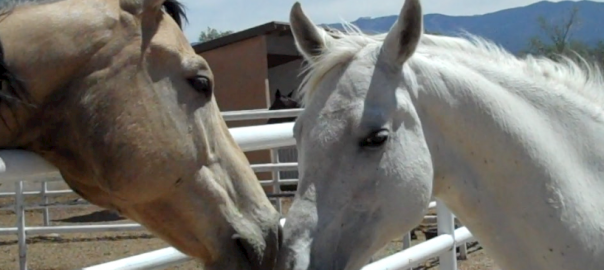
Sunday’s Horses at Liberty Clinic attracted some really good horse people here in New Mexico. Our attendees showed excellent timing and feel for the work which helped the horses learn faster.
Continue reading Horses at Liberty Training Clinic: Sharing Horse Sense
Will they like each other? Will someone get his lights punched out? What’s going to happen?
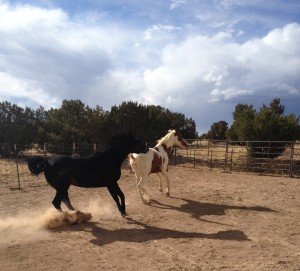
Integrating new members into your herd of horses can be an interesting time. Recently I moved our gelding Patches in with our 24-year-old gelding Khami and 21-year-old mare, Zuzka. These two have been friends forever and I had been hesitant to bring Patches into the fold for a couple of reasons. One, he is big and the day time space is big enough for all three, but the night time space is a little cramped. We don’t have acres of pasture, just your basic New Mexico dirt lots and arenas.
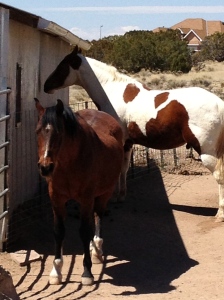
Patches had been getting aggressive with an older horse who had suffered a head injury. I’ve read that in a herd, horses may ostracize a horse that is “not right in the head.” It is a survival of the fittest activity, to keep the herd healthy and intact and to weed out any instability that might endanger the herd.
I’d always thought Patches wasn’t completely at home with the two older horses he lived with, but I liked the fact that he had physical space in their corral. I didn’t like what I was seeing when he began harassing the sick horse. It impacted my training with Patches to have him turn aggressive like this. He has always been a very quiet horse and low man on the totem pole. I need him to be quiet because he is a wonderful horse for the grandchildren to ride. In that herd, he stood apart from the others most of the time.
Immediately after I moved him in with Khami and Zuzka, he shifted back to his polite self. He did get pushed around a bit by them in the beginning, a few bites and scratches, mostly from the mare. He stood apart from them, quietly sharing territory. Khami enjoys having Patches to play with because he loves having another boy around who likes to play games like “Bite my Face.” Of course, both of them have some fur missing because of this but I don’t care because it makes them happy and fun to watch, and it’s relatively harmless.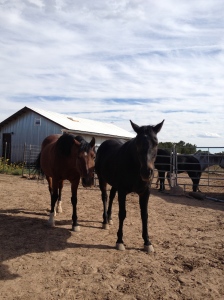
Making these changes in my herd makes my training easier. The herd takes care of behaviors that are unacceptable without my having to do it. I remember a trainer telling me years ago that moving my mare in with Khami made her life easier because my mare was managed by him. That way the trainer didn’t have to work so hard to train the mare because Khami was doing a large part of the work.
These situations don’t always work out so amicably. You have to assess the quality of the relationships between the horses, because like us, they like some horses better than others. Some combinations just don’t work. Space also has a lot to do with it. If you don’t have a lot of space, then it’s more important that they get along well. They can work out a lot of disagreements more easily in a larger space with more to interest them.
What Khami does so beautifully is lead everybody from behind. He needs to be led from behind himself sometimes as he can get overly bossy, but he makes sure there is order in the group. Putting Patches in with Khami and Zuzka has also given Zuzka something else to do – she leads him from behind too and goes after him if he stands in the wrong place. It gives Khami a break because he doesn’t have to do all the work.
Things are still shifting in this small herd of three. I noticed the other day that Patches had a new bit of hair missing from his hindquarters. And then I noticed he was standing sleeping in Zuzka’s favorite spot. She was off gazing at the cows in the adjacent pasture. She has always pushed Patches off that spot with vehemence. When I went to greet Patches, Zuzka came over to say hello to me. She greeted him too very politely. She still did not make any faces at him or push him away.
Patches is looking increasingly comfortable with the two old friends and he doesn’t look so “apart” from them now. Of course he stands out because he’s a big bright Paint and they are little brown Arabs. But I catch him and Khami sharing a hay bag, or sleeping companionably side by side.
This also gives me more opportunities to observe herd behavior. Even if horses don’t live in a big herd, the same rules apply. It is these rules that we use in the Horses at Liberty Foundation work. These small interactions may seem funny to us but they mean the world to horses. They are how they live and survive.
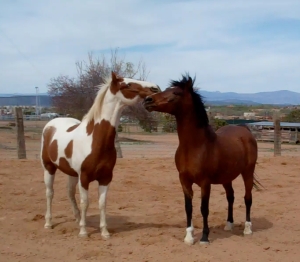
This is what I teach in the Liberty Foundation Training Clinics. See the following blog to find out what we may do in the upcoming May 26th clinic.
Santa Fe Spring Clinic Builds the Working Bond with Horses
(copyright Susan Smith)
Bodywork: private sessions, tutorials, phone consultations, distance healing and gift certificates
Liberty Training: clinics, workshops, private sessions, tutorials, consultations: by appointment: 505.501.2478 or emailing susansmith@orthohorse.info
My upcoming Horses at Liberty Foundation Clinic will be held May 26 in Santa Fe. Cost is $150. Contact me if interested! susansmith@orthohorse.info
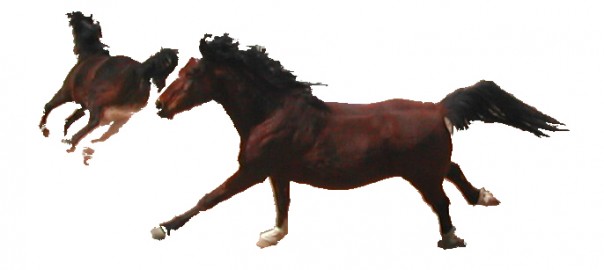
Just because we are doing liberty work it doesn’t mean that the horse is at liberty to boss us around. We are working with boundaries, territory, food, all things that are very important to horses.
I have been thinking a lot about how people approach competition with horses and how to nurture our relationships with our horses while we are asking them to perform for us. The reason why is because a lot of times horses experience burnout, as a result of their humans pushing for some kind of success.
Which is it: behavior or physical pain?
This question came up in a recent discussion regarding horses and is one that comes up in treatment quite frequently. My answer to this question is this: I will treat the body first and find out if there are any reasons why the horse might be experiencing discomfort. I will also ask questions about her lifestyle – whether there have been changes in living situations, feed, exercise, etc. that might impact the horse.
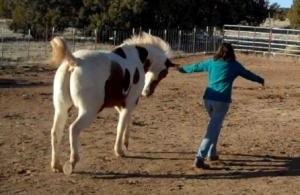
Some horses are very stoic and although they are lame they won’t complain about a saddle going on or being asked to work. Others may appear sluggish or balky or actually pin their ears and kick out when asked to do anything that might involve pain. They just don’t want to be messed with. If I work with the horse for awhile, problems will come up that we’ll be able to address and hopefully the behavior will go away.
If the horse is physically fit and has been checked out by a veterinarian as well, and is still experiencing what appear to be “behavioral” problems, then we need to look at what is making her unhappy. Sometimes it is the way the owner has been interacting with the horse. This doesn’t mean the owner is a bad owner, it just means possibly there is a focus on performance, or the owner is madly busy trying to pay the bills and hasn’t had any brain space to consider what the horse might need. We all find ourselves there at some point or another 🙂 Or, maybe a life change has occurred; a stablemate has gone.
An example is our horse, Patches. We purchased Patches from a Craiglist ad in August 2011 for our granddaughter, Ariana. He was advertised as a former show horse, and for the previous four years, a therapy riding horse. He knew how to do everything you asked. “Push button,” you might say. Ariana, my husband Michael and I all rode him to test him out. He was a good boy but I thought he was a little shut down, meaning I couldn’t really sense his true self.
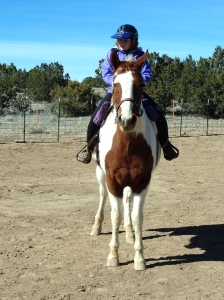 We bought him, needless to say. He is a great horse who took some time to get adjusted because he lets other horses push him around, but he’s so big and sweet you just fall in love with him, so he had a lot of support from us. He was underweight when we got him so we packed on the groceries. Now all those patches have expanded as they do with all of us in this family. He took to everything, loving
 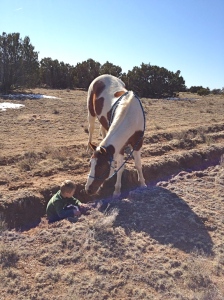 attention.
Over the winter, I began to notice some changes in his demeanor. It felt like he wasn’t able to hold it all together. He had always been cranky about having the cinch tightened, and was worse around adults, but it got so he was cranky around the kids too. I was told this cinchiness was the reason he had lost his job as a therapy horse. No one wanted to deal with him kicking out when they cinched him up. Because I’m a bodyworker, I looked at it not as behavioral but as physical. He was very constricted in the chest and sternum area, and he was a loud breather, a “roarer” as the vet would identify it. He has an epiglottal flap that closes over the larynx and impairs breathing. I began to wonder if the problem with the cinching was in some way related to this and chest restriction. He also suffered from intermittent lameness.
Patches had been tenderfooted after trims and one day he kept lying down. The next day he was not eating, and it turned out he had pneumonia and spent the next two days after that in the horse hospital.
For his rehabilitation I worked on him a small amount each day for a couple of weeks to bring him back around. We didn’t ride him because we wanted him to not have any pressure, so took him for walks and let him graze. We did liberty work with him. To work with resistance, we set up situations that he would not have to resist.
What I also notice is that he loves to perform. He loves children and will want them in the saddle before an adult, but he is so affectionate he will put up with adults very nicely. He still has the roaring but I have him on an herbal supplement to reduce that and he is doing well.
I believe there were several things at play here. First of all, Patches may have been getting sick while he was a therapy horse, but people regarded his problems as behavioral. Some inflammation can remain residual in the body for years so he could have been sick in a way that would not show up on any tests. Secondly, not feeling well leads to a change in behavior and from that patterns emerge that may end up getting stuck and not resolve themselves without help.
When a horse begins acting crabby about something, it’s time to take stock of the whole picture, not just say, oh, he’s grouchy. Ear flattening, kicking out, biting, striking, bucking can all indicate that a horse may be experiencing pain that is unseen to us. I was recently working on a mare who travels beautifully, no lameness, no back soreness, yet when I went to lift her hind leg, she wrenched it away from me repeatedly. It has taken a couple of sessions for her to let me even touch the hind leg. There was pain at the hip and there is a small amount of atrophy in the gluteal muscles on the same side of the haunch. This is unusual for a horse that is getting good exercise and turnout. Yet attention needs to be given to this even though she travels well and isn’t lame, because it’s hurting her.
What is good about this situation is the horse can remain in training yet receive bodywork to heal from within. Already after a couple of sessions it’s much better. Sometimes, however, a horse will need to be pulled out of training just to let the body heal, either physically or mentally, or both. That’s what we did with Patches, however, we were still able to do Liberty Foundation Training with him during that healing time.
In another case, a mare didn’t want to walk fast. I felt no restriction in her body when I did bodywork on her, so we did a small amount of liberty work on her and her owner reported that she is walking out now. There are some things we can do for follow-up, to keep that enthusiasm in the walk, to keep it all lively and interesting.
This dual approach has one thing in common: in Ortho-Bionomy/Equine Positional Release bodywork, a primary focus is to “meet” the individual where they are. The same is true of the Liberty Foundation work: we start where the horse is, we do not start with our own agenda. This is why some piece of the issue can be addressed by bodywork, and another piece addressed and reinforced by the foundations.
If you think your horse would benefit from this approach, contact me to set up an appointment. susansmith@orthohorse.info 505-501-2478
(copyright Susan Smith)